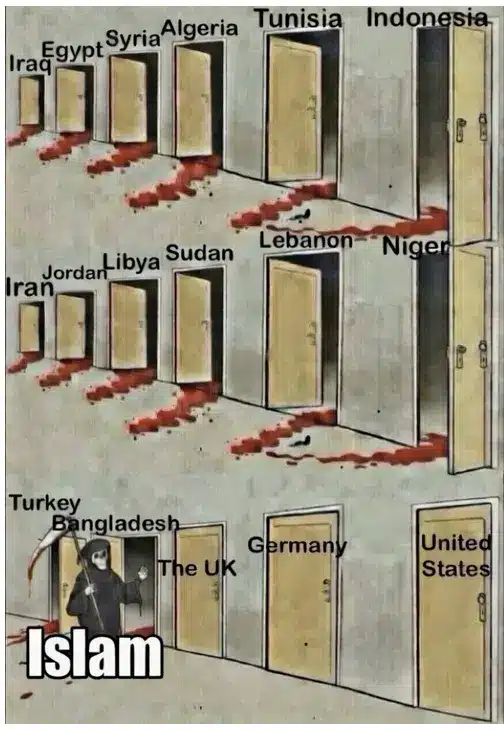

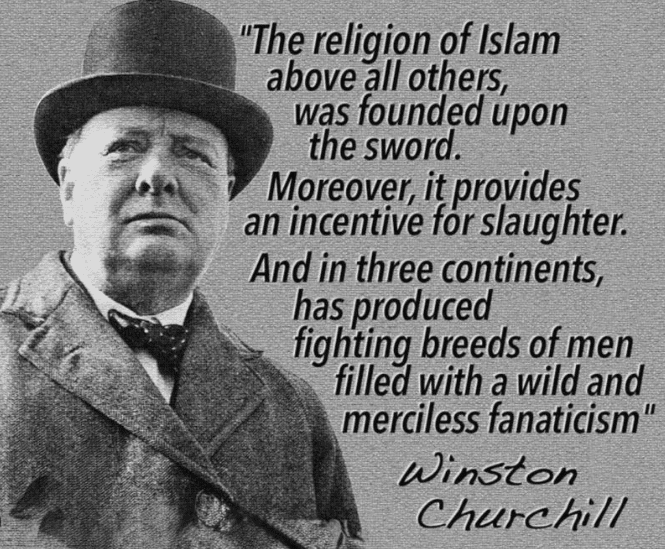
Americans have been given a preview of what they to look forward to if they just compare countries like the UK, France, Ireland and some others, ten to twenty years ago to today. Large numbers of Muslim immigrants entered those countries, built strong communities, strongly demand religious rights, that turned into a significant public presence. It’s not just some temporary trend of adaptation, but a planned process that alters the face of host countries and purposely provokes not only political disputes, but a fundamental debate about the future of the West.
Don’t lose sight that most Arab countries around the world fight political Islam by not allowing any party to grow strong enough to make religious law dominant. For example, all those states fought al-Qaeda and the terrorist organization ISIS, which primarily sought to establish an Islamic caliphate and govern countries according to Sharia law. Officially, only one country in the world currently operates under Islamic law: Afghanistan, after the takeover by the Taliban terrorist organization and the withdrawal of the American military.
The war against Islamist organizations—like the Muslim Brotherhood and other groups whose goal is to change the face of those countries—is constant. That was the case in Egypt, Tunisia, and the Gulf states, which constantly seek balance and avoid portraying the country with a distinctly Islamic character, so as not to give power and influence to religious figures. For example, regulations limiting the power of the muezzin have been enacted in these and other countries. Yet while Arab states fight Islamization at home, the organizations trying to promote it find fertile ground in Western countries.
A widely held perception among some Muslims is that Islam must lead and rule the world because their religion is the true one and the others are null and void. Thus, they view the world as divided into two: Dar al-Islam—that is, the house of Islam—countries where rule is in the hands of Muslims; and Dar al-Harb—the house of war—a term for the unbelieving countries (bilad al-kufr). These are Western countries where governance is often Christian, and therefore, in their view, Muslims have a duty to fight them and turn them into Islamic states. Furthermore, according to their doctrine, Spain—once conquered by Islam—must return to its embrace, and other Western countries should come under Islamic rule.
How is this done? In recent wars, Muslims have proven unable to even defend their own countries because of dependence on the West, lack of technology and armaments, and other reasons. Therefore, whereas in the distant past Islam expanded through conquests, massacres, forced conversions, and population expulsions, the most effective way now is legally, through demography and democracy, or in one word: immigration.
Hundreds of thousands of Muslim immigrants, once settled in Western countries, demand many rights such as building mosques and schools, halal food, and more, and anyone who does not accede to these demands is labeled Islamophobic or anti-Islam. Often, Western countries grant all these rights to Muslims, yet the latter’s ultimate loyalty is to their religious laws rather than to the host state. Moreover, once those immigrants become full citizens, they rebel against the very countries that opened their doors and demand the implementation of Islamic laws.
The West is changed gradually: first through the strengthening of immigrant communities, and then, at its peak, when Muslim holidays are marked by prayers held not in mosques but on main roads, in squares, and in parks as displays of strength and influence.
Are Muslims capable of living alongside and respecting the freedom of those who do not share their path and values, or in general, the ways of Western life? Doubtful. The World Cup held in Qatar in October 2022 showed us how life is managed in an Islamic state under Islamist rule, even if relatively moderate. There, the authorities banned the sale of alcohol to fans and the sale of pork products, and they did not allow entry to stadiums for anyone wearing clothing linked to Christian symbols or LGBTQ symbols.
The refusal to accept the “other” by many Muslims is a phenomenon that Western countries have suffered from for more than a decade, expressed, among other things, in the burning of hundreds of churches in the past ten years in Europe and Canada. The prevailing assessment is that extremist Muslims burned these churches, since such an act symbolizes war against Christianity. For example, in their battle against the Druze in 2025, Syrian regime forces burned six churches in the Suwayda district.
The discourse on Islamization in Europe and the West raises questions about Islam’s treatment of minorities once it becomes the majority. A clear case study can be found in Dearborn, Michigan, in the U.S., home to one of the largest concentrations of Muslims, who make up more than half of the population (many of them from the Shiite community). Dearborn, which hosts the largest Islamic center in North America, has already earned on social media the nicknames “the Jihad capital of America” or “the Islam capital of America,” partly due to pro-Hezbollah rallies held there. It is also known for its sweeping support of Palestinians and Iranian proxy groups designated as terrorist organizations.
About three years ago, Abdullah Hammoud—a Shiite of Lebanese descent—was elected the first Muslim mayor of Dearborn and immediately appointed a Muslim police chief, Issa Shahin. One of Hammoud’s first policies was the official recognition of Muslim holidays as paid leave, as well as allowing the public call to prayer (adhan).
Recently, the mayor made headlines after clashing with a resident who filed a complaint against his decision to name a city street after a journalist supportive of Hezbollah. Hammoud told the Christian resident, “You are an Islamophobe even though you live here. I want you to know that as a resident, you are not welcome in this city… The day you leave, I will celebrate with a parade in the streets. You are not someone who believes in coexistence but does everything to undermine it.”
These are small glimpses of what happens when extremist Muslims take over a Western city—not to mention mass prayers, violence against women, and against homosexuals. This is not science fiction or exaggeration. Studies in Europe have proven it, and it is no coincidence that Sweden has been singled out as a place where rapes are especially prevalent because of crimes committed by those immigrants against women.
Because of so many other crisis underway, the Islamic takeover of America flies mainly under the radar. If you wonder what it can lead to, just visit the UK, France, Ireland and elsewhere to see what happens when it really gets rolling. It’s when, not if, here in the U.S.